If you woke up this morning to an email from Anthropic, you already know. Starting today at 12pm PT, Claude subscriptions no longer cover usage through third-party tools like OpenClaw or OpenCode. Just like that, thousands of developers who built their workflows on those tools are facing a hard choice: switch to pay-as-you-go API billing, migrate to a different model provider entirely, or find another path forward.
We want to address this directly because a lot of CodePulse users have been asking the same question since Boris Cherny's announcement hit their feeds yesterday:
"Is CodePulse affected by this?"
No. And not by luck — by design. Every line of code we wrote for the last eight months was shaped by a single architectural decision: CodePulse does not touch your Claude Code subscription token. It does not impersonate the Claude Code binary. It does not bypass the rate limits Anthropic built into the subscription tier. It runs the real Claude Code CLI as a supervised subprocess, and every API call that leaves your machine is issued by that real binary — the same one you ran five minutes ago from your terminal.
Here is the full story of what Anthropic did, why the tools that got banned were always on borrowed time, and exactly why the April 4 enforcement left CodePulse completely untouched.
What Anthropic Actually Did — and Why They Did It
This has been building since January 9, 2026. That morning, Anthropic quietly deployed server-side safeguards that rejected subscription OAuth tokens from any tool that was not the genuine Claude Code CLI. The error message was blunt and final:
"This credential is only authorized for use with Claude Code and cannot be used for other API requests."
By February 17–19, Anthropic formalized the policy in their legal terms: OAuth tokens issued under Free, Pro, and Max plans are exclusively for Claude Code and Claude.ai. Using them in any other product — including the Agent SDK, custom harnesses, or wrapper scripts that impersonated the CLI — was now an explicit violation of the Consumer Terms of Service. OpenCode responded the same week by removing every line of Claude OAuth handling code from their repository, citing direct legal contact from Anthropic.
Yesterday, April 3, Boris Cherny — Head of Claude Code at Anthropic — announced the billing enforcement live:
"Starting tomorrow at 12pm PT, Claude subscriptions will no longer cover usage on third-party tools like OpenClaw. You can still use these tools with your Claude login via extra usage bundles (now available at a discount), or with a Claude API key."
The stated reason was straightforward: third-party harnesses were generating an "outsized strain" on infrastructure. But the underlying math tells the real story. A flat $200/month Claude Max subscription was being used to run compute workloads worth many multiples of that price through harnesses like OpenClaw. The rate-limiting governor built into Claude Code's subscription tier — the part that makes flat pricing economically sustainable — was being bypassed entirely.
That is subscription arbitrage at scale. Anthropic's patience ran out, and enforcement began with OpenClaw and OpenCode. The company explicitly stated it will roll out to all third-party harnesses in the coming weeks. If you are running your workflow on a tool that impersonates Claude Code to call the API directly, your clock is already counting down.
The Architecture That Got Banned
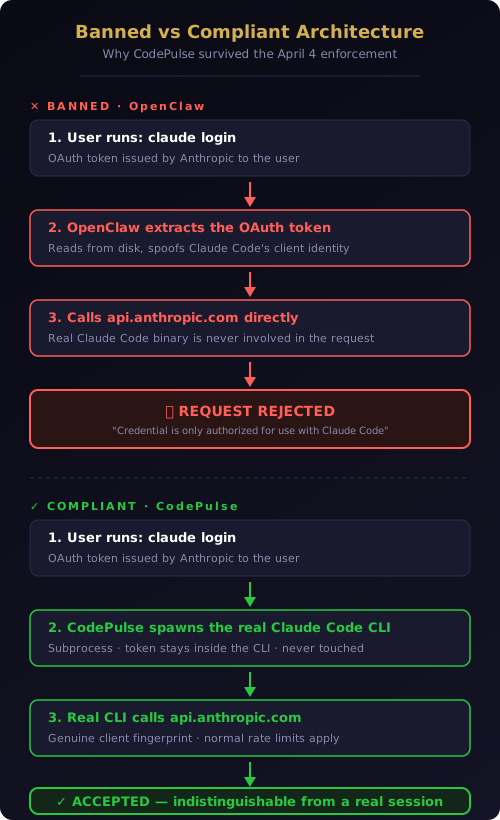
To understand why CodePulse is safe, you need to understand exactly what the banned tools were doing. OpenClaw, OpenCode, and similar projects were subscription arbitrageurs in the most technical sense possible. Here is their architecture in plain terms:
User authenticates → OpenClaw extracts the OAuth token from disk
                   → OpenClaw spoofs Claude Code's client identity headers
                   → OpenClaw calls api.anthropic.com directly
                   → The real Claude Code binary is never involved
The real Claude Code executable was bypassed entirely. These tools read the OAuth token out of the Claude Code credential store, then mimicked the CLI's API client — same auth flow, same headers, but a completely different runtime. The rate-limiting governor that Claude Code's subscription model depends on was removed in the process. Anthropic's server-side enforcement — client fingerprinting, OAuth token origin checks, and behavioral pattern analysis of request rates — now catches and rejects this pattern the moment it hits their API.
That is what is banned. And CodePulse does not do any of it.
How CodePulse Is Structurally Different
CodePulse is a supervisor, not a bypass. The Claude Code hooks system lets us insert ourselves between Claude's planned actions and their execution — without ever touching the auth layer underneath. Here is our architecture in the same plain terms:
User runs: claude login  (real, legitimate Claude Code auth)
         → CodePulse spawns the real Claude Code binary as a child process
         → The OAuth token stays inside Claude Code — CodePulse never reads it
         → Every API request originates from the genuine Claude Code runtime
         → Anthropic's server-side checks all pass — because it is the real client
Every single request to Anthropic's servers comes from the authentic Claude Code binary, with its genuine client fingerprint, its real user-agent, its normal behavioral patterns. Because that is what is running. CodePulse orchestrates the stdin and stdout of Claude Code — it does not replace the binary or reimplement its API client.
From Anthropic's infrastructure perspective, a CodePulse session looks identical to a developer running Claude Code from their terminal. We send user messages to the subprocess via stdin, we read structured NDJSON output from stdout, and we intercept the permission prompts using Anthropic's documented hook system. That is not a workaround. That is literally the design pattern Anthropic published.
This is the same philosophy behind why we built CodePulse as a supervisor rather than another AI agent. The supervisor model was always the point — not a fallback we chose after running out of options.
The Compliance-by-Design Checklist
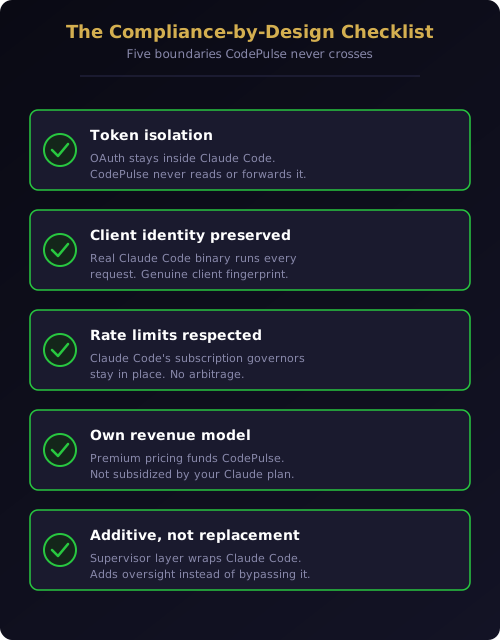
If you want to build a tool on top of Claude Code that will not get banned when Anthropic tightens its enforcement further, here is the checklist CodePulse has followed since version 0.1. These are not retrofit justifications. They are design constraints we wrote down on day one and never violated:
-
Token isolation. OAuth credentials must never leave the Claude Code process boundary. CodePulse never reads the Anthropic credential store, never extracts tokens from disk, and never forwards them to any other service. The token exists in exactly one place: wherever Claude Code puts it.
-
Client identity preserved. Every API request is issued by the real Claude Code binary. We do not ship a reimplemented API client, we do not send requests directly to
api.anthropic.com, and we do not spoof the Claude Code user-agent from any other runtime. If Anthropic fingerprints the client, our fingerprint is Claude Code because we are running Claude Code. -
Rate limits respected. The subscription tier's rate-limiting governor stays in place. We do not pool tokens across users, we do not bypass the CLI's internal throttling, and we do not run parallel requests that would exceed a legitimate single-user session. One CodePulse user looks exactly like one developer at a terminal.
-
Own revenue model. CodePulse earns its money from its own premium plan — $9.99 per month for voice input, git automation, project memory, and the other features that make remote development practical. We are not subsidized by your Claude subscription. Anthropic's economics and our economics do not collide.
-
Additive, not replacement. CodePulse wraps Claude Code to add approval oversight and remote control. Our Claude Code Telegram comparison shows why the supervisor model consistently wins on safety against every alternative. We do not attempt to replicate Claude Code — we assume it exists, respect its boundaries, and add what it does not have.
These five constraints are the reason CodePulse shipped through April 4 without a single line of code changing.
The Timeline: Four Months of Warnings CodePulse Could Ignore
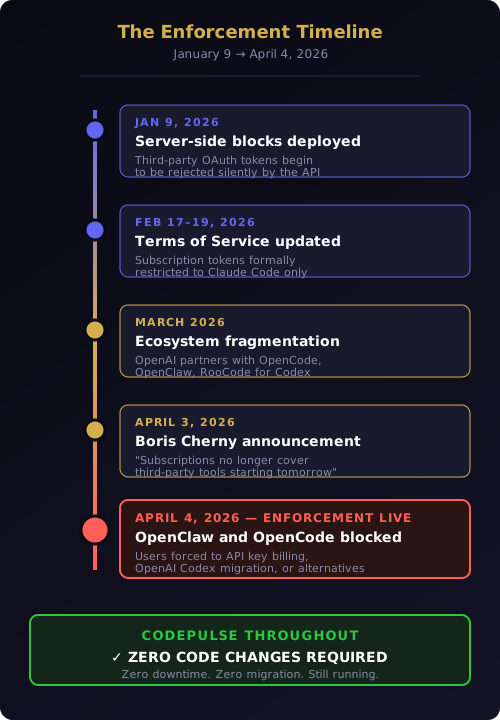
The crackdown did not happen overnight. Anthropic has been tightening this policy for four months, and at every step CodePulse continued shipping as if nothing was happening. Here is the sequence:
- January 9, 2026 — Server-side blocks deployed. Third-party OAuth tokens began getting rejected silently.
- February 17–19 — Terms of Service updated to formalize the ban. OpenCode removed Claude OAuth code citing "direct Anthropic legal requests."
- March 2026 — OpenAI partnered with OpenCode, OpenClaw, and RooCode, offering Codex subscription support as an alternative Claude replacement. The ecosystem fragmented along model-provider lines.
- April 3, 2026 — Boris Cherny announced the billing enforcement live on X, effective the next day.
- April 4, 2026 — Enforcement live. Third-party harnesses now require Extra Usage billing or API keys.
Throughout every one of those events, CodePulse required zero changes. Not because we got lucky with the enforcement roll-out order. Because we built on top of Claude Code rather than around it. The banned tools had four months of warning and tried to negotiate a path forward. CodePulse did not need to negotiate anything because we were never on the list.
Three Paths Forward — And Only One Makes Sense
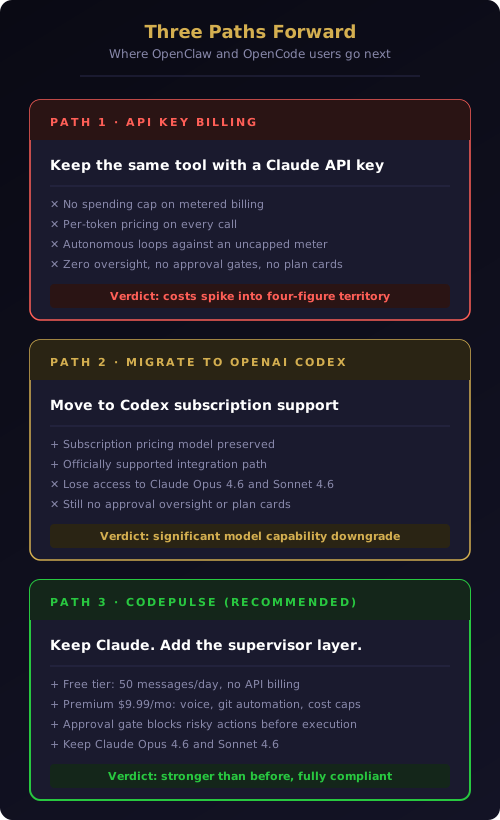
Developers who relied on OpenClaw or OpenCode are staring down three realistic paths right now. We have talked to enough migrating users in the last 48 hours to lay out the trade-offs clearly.
Path 1: API key billing. You can keep using these tools with a Claude API key. The catch is significant: no hard spending cap, per-token billing on every single call, and the same autonomous loops that ran comfortably on a flat subscription now run against an uncapped meter. Heavy agentic workflows that fit inside a $200/month subscription can spike into four-figure territory on metered billing. And you still get zero oversight — no approval gates before a rm -rf, no plan cards showing cost estimates before execution, no pre-execution review of what Claude is about to do.
Path 2: Switch to OpenAI Codex. OpenAI is actively recruiting OpenClaw and OpenCode users, offering Codex subscription support for third-party tools as an olive branch. The model capability trade-off is real, though. You are moving off Claude Opus 4.6 and Sonnet 4.6, which are currently the strongest coding models available by a meaningful margin. The entire migration exists because your tool broke, not because the new model is better.
Path 3: CodePulse. Keep Claude. Keep your subscription economics — see the CodePulse pricing page for a free tier that requires no API billing at all. Add something you never had before: actual oversight. Our 7-step approval pipeline catches risky commands before they run. The Telegram voice input workflow turns your phone into a remote coding terminal. Plan cards show cost estimates before a single token is spent. Git automation includes commit message review. A 40-second voice auto-confirm window. Notification intelligence that silences Telegram during file reads and wakes you up for the things that matter.
For Existing OpenClaw and OpenCode Users
If you are migrating right now, here is what CodePulse gives you that you have been missing. These are not features we hastily added after the enforcement announcement — they have been the core of the product since launch.
The approval gate. Before Claude reads a file, writes a function, or runs a bash command, CodePulse asks you first. You see exactly what is about to happen on your phone. You allow it, deny it, or deny it with instructions — and Claude recalibrates without losing session context. OpenClaw never had this because it could not. It was designed around unsupervised autonomous execution, and the architecture that let it bypass rate limits also made supervised approval impossible. Our approval engine learns your patterns over time and stops asking about routine safe actions while keeping every dangerous command behind a manual tap.
A cost hard stop. Configure a session budget. At 80% of the budget, you get a Telegram warning with the current spend. At 100%, the session terminates cleanly with the work-in-progress preserved. On API billing with no spending cap, this is the feature you need most. Every one of our CodePulse pricing plans includes it from the start.
Voice from your phone. Send a voice message. CodePulse transcribes it via gpt-4o-mini-transcribe through our Cloudflare Worker — no personal OpenAI API key required. You have 40 seconds to review the transcription and hit cancel before it auto-confirms. It is the closest thing to walking up to your desk and talking to your terminal from anywhere in the world. Going from terminal to Telegram should feel like texting a colleague, not like operating a piece of industrial machinery.
Project memory. CodePulse auto-discovers your codebase on first access — language, framework, test commands, file structure, recent git activity. That context is injected into every Claude session automatically. Claude starts each task already knowing your project, not asking you to explain it again.
AI commit review before push. Before any commit leaves your machine, our AI commit review pipeline catches bugs Claude missed during the session by running a fresh review against the final diff. This is the layer OpenClaw structurally could not have because it did not supervise execution.
Emergency stop. One button in Telegram kills the session instantly, preserves the work, and keeps the approval state intact. When Claude is running a task you suddenly want to abort, you do not need to be at your desk. Every architectural decision about how we run Claude Code was built around making this one button possible.
Why This Matters for Serious Developers
Here is what is actually being revealed by this enforcement. Flat-rate subscriptions and fully autonomous overnight AI loops are fundamentally incompatible economics. The math breaks down under the simplest stress test. Anthropic closed the arbitrage because subsidizing $5,000 workloads with $200 subscriptions is not a business model, it is a runway burn. Other providers will follow the same pattern — Google already restricted AI Ultra subscribers who used third-party harnesses for identical reasons.
The tooling ecosystem that survives this shift will not be the one that found the most clever workaround. It will be the one that built a model Anthropic can live with: tools that run inside Claude Code's session accounting, generate their own revenue rather than exploiting subscription limits, and add capabilities that make Claude Code more powerful rather than cheaper through arbitrage.
That is exactly what CodePulse was built to be from day one. A supervisor, not a bypass. A commercial product with its own pricing model. An orchestration layer that Anthropic's telemetry sees as ordinary, compliant Claude Code usage — because it is. Our local-first architecture makes this guarantee possible: nothing runs on our servers, nothing about your Claude session is mediated through a third party, and the only network traffic between you and Anthropic is the traffic Claude Code itself generates.
One More Thing
Boris Cherny personally submitted pull requests to improve prompt cache hit rates for OpenClaw specifically to reduce costs for users who would be migrating to API billing. That is not the behavior of a company that is hostile to the developer ecosystem. It is the behavior of a company drawing a line around economic sustainability while actively trying to soften the landing for affected users.
We think that is fair. And we think CodePulse is exactly the kind of tool Anthropic wants to see succeed: one that genuinely enhances Claude Code, adds oversight that makes AI development safer, and earns its revenue through its own value — not through subscription arbitrage.
The door that closed today was not a door CodePulse ever walked through.
Ready to migrate from a tool that just broke, or set up a real supervisor layer for your Claude Code workflow for the first time? Download CodePulse and keep your Claude subscription intact. The free tier pricing gives you 50 messages per day with the full approval pipeline — upgrade to Premium for the full feature list that makes remote AI development actually work.