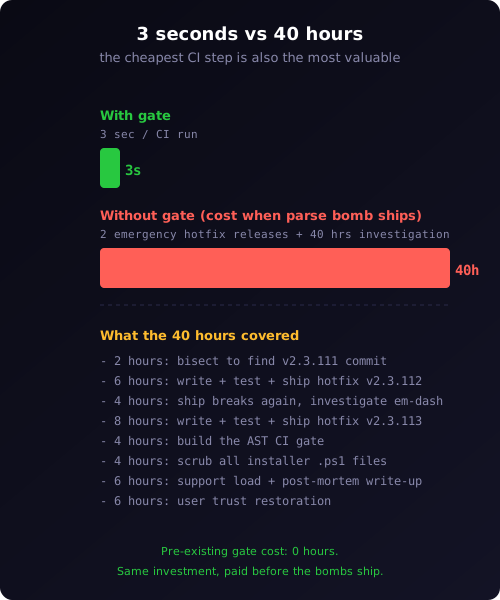
We added a tiny step to our GitHub Actions release workflow after two consecutive production releases shipped with PowerShell parse-time bombs. The step runs in about three seconds. It walks every .ps1 file in our installer directory, parses it with PowerShell's own AST, and fails the workflow if any file has a parse error or contains non-ASCII bytes without a UTF-8 BOM. The cost of running it on every release is negligible. The cost of not running it was two emergency hotfix releases in 48 hours, both of which broke 100% of new installs and produced no diagnostic output for affected users.
The gate is a specific instance of a general pattern: run the target runtime's parser against every interpreted-language file in CI, before any expensive build step. The general pattern works for PowerShell, Python, Bash, Node.js, JSON, YAML, and TOML — anywhere your release artifact contains a file whose runtime is not a binary. This article is the playbook.
Why the cheapest CI step is the most valuable one
Most CI investments add capability. New tests. New static analysis. New linting rules. They run, they sometimes fail, and the failures point at code defects that need attention. The value is real but the cost is also real — every check has a runtime, a maintenance burden, and a probability of false positives that wastes engineering time.
A parse-check gate is a different shape of investment. It does not look for code defects. It asks one question: will the runtime that loads this file actually be able to load it? If the answer is no, the gate fails immediately, and the failure points at exactly which file and exactly which line. False-positive rate is essentially zero, because the check is the runtime's own parser. Maintenance burden is essentially zero, because the parser is a stable platform API.
The disproportionate value comes from where this kind of failure surfaces if you do not catch it in CI. A parse error fires before any line of code runs. That means it fires before your error-handling fires, before your logging fires, before your runtime telemetry fires. From the operating system's perspective, your script returned exit code 1 and produced no output. From your support team's perspective, you have a user with an unrunnable artifact and no useful diagnostic. From your release pipeline's perspective, the build succeeded — the parse error happens at the user's runtime, not yours.
That diagnostic-surface collapse is the part that makes parse bombs so expensive. Catching them in CI does not just save the cost of one ten-minute build. It saves the cost of every support escalation, every rollback decision, and every "wait, why is the log empty?" debugging session that downstream failures would have caused. We measured the cost of our two parse bombs at roughly forty engineering hours of investigation, hotfix, and follow-up. The CI gate that prevents both of them runs in three seconds per CI invocation.
The PowerShell version of the gate
Our gate runs as the third or fourth step in release.yml, after the OS-toolchain installation but before any code generation, compilation, or packaging. It is roughly 30 lines of PowerShell. The full source is checked in to our .github/workflows/release.yml; the version below is annotated for clarity:
$failed = 0
Get-ChildItem -Path install -Recurse -Filter '*.ps1' | ForEach-Object {
  # 1. AST parse check using PowerShell's own parser
  $errors = $null; $tokens = $null
  [System.Management.Automation.Language.Parser]::ParseFile(
      $_.FullName, [ref]$tokens, [ref]$errors) | Out-Null
  if ($errors.Count -gt 0) {
    Write-Host "::error file=$($_.FullName)::PARSE ERROR in $($_.Name)"
    foreach ($e in $errors) {
      Write-Host "  L$($e.Extent.StartLineNumber): $($e.Message)"
    }
    $failed++
  }

  # 2. Encoding check: pure ASCII OR UTF-8 with BOM, nothing else
  $bytes = [System.IO.File]::ReadAllBytes($_.FullName)
  $hasBom = ($bytes.Length -ge 3 -and $bytes[0] -eq 0xEF
             -and $bytes[1] -eq 0xBB -and $bytes[2] -eq 0xBF)
  $hasNonAscii = $false
  foreach ($b in $bytes) {
    if ($b -gt 127) { $hasNonAscii = $true; break }
  }
  if ($hasNonAscii -and -not $hasBom) {
    Write-Host "::error file=$($_.FullName)::$($_.Name) has multibyte bytes but no UTF-8 BOM -- will parse differently under non-CP1252 locales"
    $failed++
  }
}
if ($failed -gt 0) { throw "Installer .ps1 pre-flight failed: $failed file(s) rejected" }
Write-Host "All installer .ps1 files parse cleanly and are BOM/ASCII-safe."
Two distinct checks combined into one step. The AST parse catches syntax errors of the kind that v2.3.111 shipped ($Script: misread as a scope modifier). The encoding check catches the locale-dependent class of bug that v2.3.112 shipped (a UTF-8 em-dash in a BOM-less .ps1 file misread as a CP1252 closing quote). The full saga is in our parse-bomb post-mortem; the gate above is what closed both classes structurally.
The ::error GitHub Actions annotation prefix is the small but important detail. With it, every parse error appears as an inline annotation on the affected file in the GitHub Actions UI — the maintainer sees the error in context, on the line that broke. Without it, the failure appears as a generic exception in the run log and the maintainer has to grep. Two extra characters per error line, much better DX.
The same pattern in five other languages
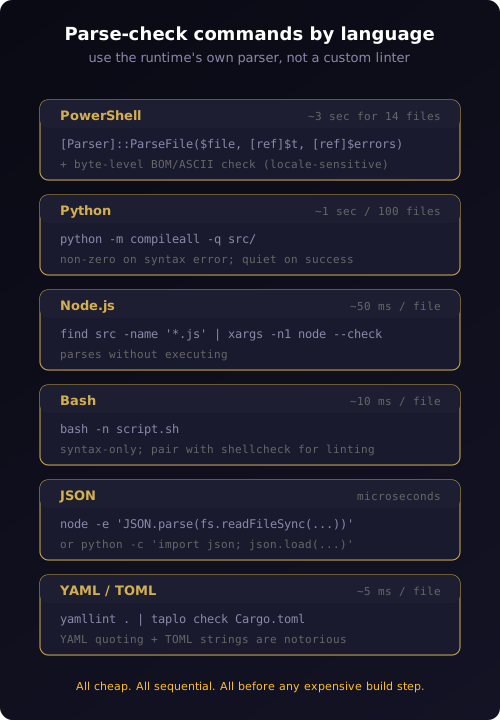
The PowerShell case is specific. The pattern is general. Every interpreted language ships its own parser as a callable command. Use it.
Python: python -m py_compile <file>.py parses and byte-compiles the file. Returns non-zero on syntax error. Use python -m compileall <directory> to recurse. Add -q to suppress chatty success output.
python -m compileall -q src/ || exit 1
Node.js: node --check <file>.js parses without executing. Returns non-zero on syntax error. For an entire directory, glob it:
find src -name '*.js' -print0 | xargs -0 -n1 node --check || exit 1
Bash: bash -n <file>.sh runs the parser without executing. Same shape; same return semantics. Note that -n does not do shellcheck-style linting — it only checks that the script parses. Pair it with shellcheck for richer static analysis.
JSON: python -c 'import json, sys; json.load(open(sys.argv[1]))' is the canonical one-liner. For Node.js environments, node -e 'JSON.parse(require("fs").readFileSync(process.argv[1]))'. Either way, the cost is microseconds per file and the failure is precise.
YAML: python -c 'import yaml, sys; yaml.safe_load(open(sys.argv[1]))' parses with PyYAML. For stricter checks, yamllint adds linting on top of parsing. YAML's quoting rules are notorious for failing in surprising ways, so this gate is especially valuable for .github/workflows/*.yml files.
TOML: python -c 'import tomllib, sys; tomllib.load(open(sys.argv[1], "rb"))' (Python 3.11+) or taplo check (Rust binary, faster). Worth gating any Cargo.toml, pyproject.toml, or wrangler.toml that ships in your release artifact.
The pattern across all of these is the same: the target runtime's own parser is the source of truth. Custom linters, IDE syntax-highlighters, and language-server diagnostics are useful for editor feedback, but they are not the parser that the user's runtime will execute. Only the runtime's parser tells you whether the file will load. Run the runtime's parser. Run it cheaply. Run it before any expensive build step.
Where the gate goes in your pipeline
The placement matters more than it sounds. The gate should run as early as possible after the toolchain that contains its parser is installed. For our release workflow, that is right after actions/setup-node and the PowerShell-on-Windows install, before any of the seven build steps that follow.
The principle: if the gate is going to fail, it should fail in the cheapest part of the run. CI minutes are cheap individually but expensive in aggregate. A parse-bomb caught at minute 0:30 of a 12-minute workflow saves 11.5 minutes of compute and gets the maintainer the error message 11.5 minutes earlier. Both savings compound across hundreds of CI runs per month.
The corollary placement rule: do not put the gate after a step that depends on the file being valid. If your build step also fails on the parse error (because it loads the file), the build step's failure obscures the gate's clearer message. The gate exists to give precise diagnostics; let it speak first.
A common mistake is to add the gate as part of a "lint" job that runs in parallel with the build. Parallel CI is good for throughput but bad for pre-flight gates — the build runs to completion (and consumes minutes) even when the gate fails. Sequential placement, with the gate as a hard prerequisite for the build, is the right shape for any check whose purpose is to prevent the build.
The encoding rule that catches what the parser misses
The PowerShell-specific encoding check above (lines 13–22 of the gate script) is the part that surprises most teams when they hit it. The PowerShell parser will accept a file with a UTF-8 em-dash inside a string and report no error — if the parser's reading codepage matches the author's writing codepage. The bug fires only on a runtime where the codepages differ.
This is a class of bug that the AST parser cannot catch alone, because the AST parser running in CI uses the same codepage that successfully reads the file. Catching it requires a separate check at the byte level, asking "does this file use multibyte characters without a BOM?" If yes, the file will parse correctly on the developer's machine and incorrectly on a Japanese, Turkish, or even default English Windows install. The check costs about 50 microseconds per file; it would have caught our v2.3.112 hotfix the moment it was committed.
The same byte-level concern applies to other locale-sensitive runtimes. Python 2 had its own encoding declaration (# -*- coding: utf-8 -*-) that PEP 263 made optional and most files omitted; the consequence was Python 2 reading source files in the system default encoding, which differed by locale, with the same class of bug. Python 3 standardised on UTF-8 by default but Windows-installed Python still has surprises around cp1252 for stdin handling. Bash scripts loaded by non-bash shells (/bin/sh, dash, ksh) hit similar issues.
The general defensive habit: if your release artifact contains a file whose runtime is locale-sensitive, gate the file's encoding in CI. Pick one of "pure ASCII" or "explicit BOM/encoding declaration" and enforce it mechanically. Author memory is not enough. The gate is the structural protection.
Why this is more valuable as your team grows
A two-person engineering team has informal protections against parse bombs. Both people read every commit. Both people recognize the in-house style. The author personally tests the file before pushing. These protections work, badly, until the team grows past the point where any one person reads every commit.
Past that point — typically around five to seven engineers — the protection has to become structural. The gate is the structural form of "did anyone parse-check this file?" It scales linearly with the codebase, not with the team. It runs every time, regardless of who pushed. It catches the new contributor's first PowerShell file as readily as the principal engineer's two-hundredth.
The same logic generalises beyond parse-checking. Any check whose absence depends on author memory becomes a structural risk as soon as the team gets large enough that no individual author has the full context. Encoding checks. Lint rules. License-file presence. Dependency-version compatibility. Schema-validation of YAML/JSON config. All of these are candidates for the same shape of gate: cheap, precise, sequential before expensive steps, structurally enforced.
For the release pipeline specifically we adopted three additional gates after the parse-bomb saga, in the same spirit. A tsc --noEmit check on the service code. A cargo check on the launcher Rust code. A bunx vitest run on the unit tests. None individually exotic. All cheap. All sequential before any compilation step. All driven by the principle that the cheapest place to catch a defect is also the most valuable.
What to do this week if you ship interpreted-language files
The diagnostic takes about ten minutes.
List every interpreted-language file in your release artifact. Greppable categories: *.ps1, *.py, *.js, *.sh, *.json, *.yml, *.yaml, *.toml. If your installer ships a .config.js or a package.json or a .env.example, those count too.
Match each category to its parse-check command. Use the table above. For an unusual runtime, look up "parse without executing" or "syntax check only" for that language — every interpreted language has the API.
Add a single CI step that runs all the parse-checks at the start of your build workflow, before the expensive compilation step. Use ::error annotations (GitHub Actions) or your CI's equivalent for inline error visibility.
For locale-sensitive runtimes (PowerShell, older Python, some shells), add a byte-level encoding check. Pure ASCII or explicit BOM. The check is 10 lines.
Run a smoke build to confirm the gate actually fails on a known-bad file. Stage a deliberate parse error in a feature branch, push, watch the CI fail in seconds with a precise error. Revert and merge the gate. The smoke test is the part that confirms the gate will catch real bugs, not just live in your workflow as inert configuration.
Document the gate in your contributor guide. Future contributors should know that the gate exists, why it exists, and what it enforces. The documentation is what makes the gate auditable when the team grows past the point where the original author is in the room.
The total adoption cost is one to two engineering hours, depending on how many languages your artifact contains. The first time the gate catches a parse bomb that would have shipped, the investment has paid for itself for the year. The second time, you have a story like ours — a class of failure that the structural protection makes impossible, paid for once and providing returns indefinitely.
We have run twelve releases since adopting the PowerShell gate. Zero parse bombs reached production. The gate has fired on contributor branches three times — twice on legitimate syntax errors caught in three seconds, once on an em-dash that a contributor copy-pasted from a Slack message into a string literal. The em-dash catch alone saved a release. The cost of the gate, three seconds per CI run, has been paid back many times over by each individual catch.
The same shape of investment is available to any team shipping interpreted-language files. The cost is small. The savings are not.
Ready to ship without the silent-parse-bomb tax? Download CodePulse and let your phone catch the build issues your CI cannot. The free tier includes the zero-config installer and the Telegram bridge. Upgrade to Premium to unlock AI commit review, the Genius Supervisor, and voice input.