A test gate that runs is not the same as a test gate that gates. We learned this the hard way after we built one for our release pipeline, ran an adversarial review on the result, and watched it find that the gate we had just spent six hours hardening would, in fact, let broken code ship to production. The gate ran. It went green. It did not gate.
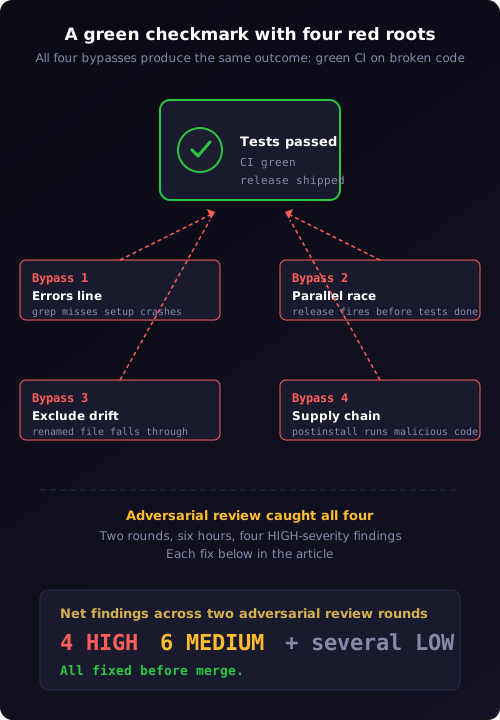
This article walks through the four specific bypasses that adversarial review surfaced — each one would have shipped if we had trusted the green CI light — and the layered defense that closes all four. The patterns are not specific to our stack. Any team that has bolted a test runner into GitHub Actions and called it a "release gate" should run the same audit on their own setup before their next deploy.
Why "the tests pass" is not the same as "the gate works"
The instinct when you set up CI tests is to wire bun run test (or pytest, or npm test) into a workflow, watch the green checkmark appear on a PR, and feel safe. That instinct is wrong, and the gap between "test runner reports success" and "the gate prevented a release of broken code" is wider than it looks. Several distinct failures all produce a green checkmark:
- The test runner crashes during setup before any tests load. The exit code is 1, but a wrapper script that parses output for the word "passed" can fall through.
- The test runner finishes after the release pipeline has already shipped. The check is informational, not blocking.
- The exclusion list in your workflow points at files that no longer exist. The runner silently runs nothing for those entries and reports green on a non-existent test set.
- Your install step runs malicious postinstall scripts from a typosquatted dependency before any test even gets a chance to fail.
Each of these failure modes survives a casual reading of the workflow file. Each of them looks like a green CI run from the outside. Each of them has happened in real codebases. The only reliable way to find them in your own pipeline is to put a hostile reader in front of the workflow YAML and ask: what's the most embarrassing way this could ship broken code while looking healthy? That's the adversarial-review process we use before any CI infrastructure change lands.
We ran it twice on a 108-line GitHub Actions workflow that we had spent the day building. Combined, the two reviews surfaced four HIGH-severity bypasses and six MEDIUM-severity issues. The rest of this article is the field guide.
Bypass 1: the "Errors N error" line that survives a syntax error
Most test runners emit a human-readable summary at the end of a run. Vitest's looks like this:
 Test Files  46 passed (46)
      Tests  1562 passed (1562)
     Errors  1 error
Notice the third line. Errors is a separate counter from Tests. It tracks unhandled errors in transform, collect, and setup phases — the things that fire before a test even gets to run. A syntax error in a test file, an unresolved import, a top-level throw in a vi.mock factory: these all increment the Errors line while the Tests line happily reports all-passed for the files that did manage to load.
Our first wrapper script grep'd for Tests +[0-9]+ failed to detect failures. The Errors line is not on the Tests line. The grep returned zero matches. The script returned zero. CI went green. A future PR introducing a syntax error in any test file would have shipped to production without warning.
The fix is not just another grep. It is structural. We switched the wrapper to write JUnit XML output (--reporter=junit --outputFile.junit=test-results.xml) and parse the root <testsuites> element's attributes (tests=, failures=, errors=). The XML format is a stable spec — every test runner that emits JUnit follows the same schema — so the parser does not need to track every cosmetic change to the human-readable output.
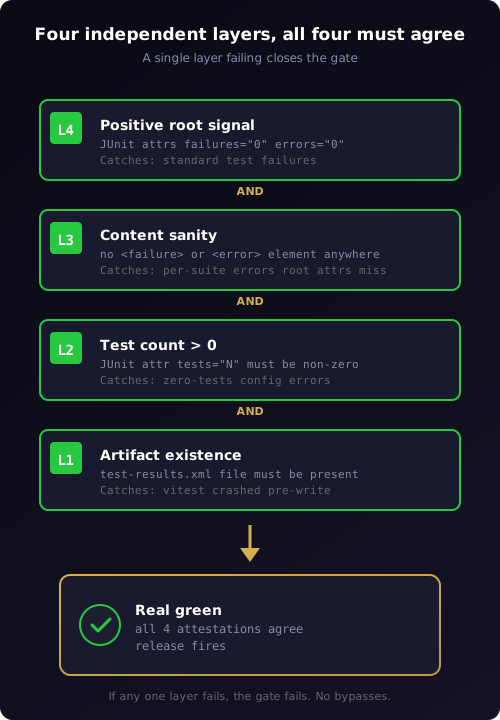
Then we added defense in depth on top of that. Even with JUnit XML parsing, vitest's reporter source code admits it cannot detect every error class — its root errors= attribute is hard-coded to 0. So the wrapper also greps for any <failure> or <error> element anywhere in the XML, and asserts the test count is non-zero (a config error that runs zero tests is itself a fail). Four layered checks, each catching a different failure mode. If any one layer trips, the gate fails.
Bypass 2: the gate that runs in parallel with the release
Our test workflow triggered on push: dev. So did our versioning.yml workflow, which runs semantic-release to compute the next version, push a tag, and dispatch the release build. Both workflows fired on the same commit. They ran on separate runners. They had no dependency relationship.
The release pipeline finished in about 30 seconds. The test workflow took 3-4 minutes on Windows. Every release tag was created, the build was uploaded to R2, and the GitHub Release was published before the tests had finished running. By the time a red checkmark appeared on the test workflow, the artifact was already public.
This is the most common form of "release gate theater" we have seen in other people's pipelines, and it is exactly what we built. The workflow file's title said "Tests" — we believed it was a gate. The architecture said otherwise.
The fix is to convert the test workflow into a reusable workflow (workflow_call: trigger) and have the versioning workflow call it as the first job, with needs: tests on the version job. The version job — and therefore semantic-release, the tag, and the release build — only runs after the test job reports success. Now there is a real dependency chain:
push to dev
  └─ versioning.yml
       ├─ tests job (calls tests.yml — Vitest + typecheck on windows)
       └─ version job (needs: tests)
            └─ semantic-release
                 └─ tag created
                      └─ release.yml (build + publish)
If tests fail, the version job is skipped because needs.tests.result != 'success'. No tag is created. No release fires. The same tests.yml still runs on PRs via the pull_request: branches: [dev] trigger, so reviewers see the result before merging. One workflow definition, two consumption contexts, no duplication.
Bypass 3: the exclusion list that silently no-ops
Our gate excluded seven test files because they had pre-existing failures we were tracking separately. The workflow line looked reasonable:
bun run test \
  --exclude='tests/unit/approval-bridge-server.test.ts' \
  --exclude='tests/unit/commit-gate.test.ts' \
  ...
What happens when one of those files is renamed? Vitest's --exclude is a glob match. A glob that matches nothing is a glob that excludes nothing. The renamed file is now included in the run. Best case: the renamed file still has the broken behavior, and the run goes red. Worst case: someone splits the broken file into two, and the new sibling file (with a slightly different name) is run with no exclusion. Either way, the workflow comment claims "we exclude these 7 files" but the reality has drifted.
The fix is a pre-flight check before vitest runs:
EXCLUDED_FILES=(
  'tests/unit/approval-bridge-server.test.ts'
  'tests/unit/commit-gate.test.ts'
  ...
)
for f in "${EXCLUDED_FILES[@]}"; do
  if [ ! -f "$f" ]; then
    echo "::error file=$f::Excluded test file no longer exists"
    exit 1
  fi
done
The same array drives both the existence check and the --exclude arguments to vitest, so there is one source of truth. Renames or deletes immediately surface in CI as a hard failure pointing at the workflow file, not a silent gap in coverage. The maintainer is forced to update the exclusion list at the same time as the test file, which is exactly the right time to update it.
The general pattern is: any "default behavior on missing input" in a CI workflow is a place where drift can hide. If your workflow says "run all tests except these 7," that "except" needs to be checked, not assumed.
Bypass 4: the supply-chain hole inside bun install
Most CI workflows install dependencies with the package manager's default flags. Ours did:
bun install
bun install runs every package's postinstall lifecycle script, exactly the way npm install does. If a transitive dependency in your tree publishes a malicious patch version — typosquatted on the registry, or a compromised maintainer account — that postinstall script gets to execute on your CI runner with full access to GITHUB_TOKEN, your registry credentials, and any environment variable your workflow sets. This is not a theoretical risk: real supply-chain attacks have used exactly this vector against Node and Python projects.
The relevant flag for any test-only workflow is --ignore-scripts:
bun install --ignore-scripts
Tests do not need postinstall execution. They do not need husky to install git hooks (CI does not commit). They do not need ffmpeg-static to download its binary (no test should be invoking ffmpeg). The exact tradeoff is project-specific — if a test legitimately depends on a postinstall side effect, you will discover it the first time the test fails — but for the vast majority of test workflows, the script execution is pure attack surface.
This is the same kind of structural fix as Bypass 3. We are not adding a new check. We are removing an implicit behavior the package manager performs by default and asking explicitly for the narrower behavior our actual use case needs.
Defense in depth: when the green light has to come from four agreeing checks
The combined fix is not "one big change." It is four independent checks, each of which has to pass for the gate to report success. Defense in depth was the explicit design after Turn 2 of adversarial review surfaced two more issues that the green CI from Turn 1 had hidden.
Layer 1 is structural: the gate is wired into the release pipeline as a hard needs: dependency, not a parallel informational check. There is no architectural path for a release to fire while tests are red.
Layer 2 is artifact existence: the parser checks that test-results.xml was actually written. A vitest crash before XML output triggers fail-fast.
Layer 3 is content sanity: the parser asserts the run executed at least one test and contains no <failure> or <error> elements anywhere. A configuration error that produces zero tests is itself a failure. A nested per-suite error that the root attribute might miss is caught.
Layer 4 is positive root signal: failures="0" and errors="0" on the JUnit <testsuites> root attributes. This is the explicit primary check.
Any one of these failing fails the workflow. The probability of all four lying simultaneously is essentially zero. This is the same pattern that financial systems, aviation systems, and nuclear systems use for safety-critical signaling: independent attestations from independent sources, agreement required.
The same mindset shaped our 7-step approval pipeline, which never auto-approves a tool call solely on one signal — it requires consensus across path safety, dangerous-command checks, learned patterns, and mode-based rules. Releases deserve the same care.
What adversarial review actually does to a CI workflow
Adversarial review is not a code review where a colleague nods approvingly. It is a process where a hostile reader is shown the artifact and asked to find every way it can fail silently, fail open, or report success on a real failure. The reviewer's job is to make the author look bad.
We run adversarial review on every non-trivial change. The CI gate work landed across seven commits on a single PR. After commit five we asked an adversarial reviewer to audit the workflow as if it were already shipped to production. The review found the four HIGH-severity bypasses above plus six MEDIUM-severity issues — output buffering, stale comment claims, deprecated GitHub Action versions, missing concurrency configuration, and so on.
After we fixed those, we ran a second adversarial review on the fixed version. Turn 2 found two more HIGH-severity bypasses that Turn 1 had missed — including the parallel-jobs problem (Bypass 2) and a missing defense-in-depth needs.tests.result == 'success' check that would have allowed a future innocent edit to silently re-open the gate.
The lesson from running two rounds: the first round always finds things. The second round always finds different things, because the first round's fixes change the failure surface. We have not yet seen a Turn 3 round that found nothing. There is always one more bypass.
This is not an indictment of the engineers writing CI workflows. CI YAML is full of implicit defaults, deprecated patterns, and runtime behavior that is not visible from reading the file. The failure modes are interesting precisely because they survive normal code review. Adversarial review is the structural answer to "we are going to make small mistakes, and we cannot rely on noticing them ourselves."
What this changes for your own pipeline
The four bypasses above are not specific to vitest, GitHub Actions, or our stack. The patterns transfer:
- Any test runner with a multi-line summary has lines beyond the obvious
passed/failedcount. Find them. Parse the structured output (JUnit, TAP, JSON), not the human summary. - Any release workflow that fires in parallel with the test workflow on the same trigger is not gating. Make the dependency explicit with
needs:or convert to a reusable workflow withworkflow_call:. - Any exclusion list or "skip these" configuration silently no-ops when paths drift. Add an existence check that fails loudly.
- Any package install in CI that does not opt out of postinstall scripts is a supply-chain surface. Add
--ignore-scripts(or equivalent) unless a specific test depends on the side effect.
These are four cheap checks. None of them require new tools, new dependencies, or new infrastructure. They are all single-line additions to a workflow YAML that pay for themselves the first time they catch something.
We built CodePulse to be the kind of release pipeline we wanted to trust. The Telegram bridge lets you watch every commit go from dev to production from your phone, the auto-updater ships fixes to users within minutes of a tag, and the gate above ensures that nothing reaches the auto-updater that has not survived a 1,562-test suite plus four layers of structural validation. The whole pipeline is the product, not just the agent that runs your tasks.
The cost of that quality bar is real — adversarial review takes time, layered defenses take more code than a single check, and workflow_call is more architecture than push: dev. The cost of not having it is also real, and it shows up later, in production, in front of users, when nothing in your CI history explains why the broken code shipped. We pay that cost up front, in CI YAML, where it is cheap.
Ready to ship code from your phone with a release pipeline that actually gates? Download CodePulse and let the Telegram bridge show you every commit's CI status from anywhere. The free tier includes the full approval pipeline and remote control — upgrade to Premium to unlock AI commit review, the Genius Supervisor, and voice input. The zero-config Windows installer gets you running in under two minutes.